
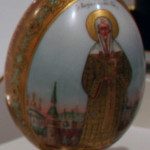
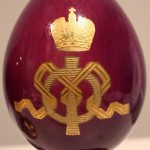
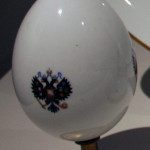
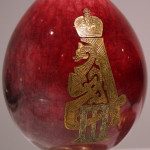
From the Gatchina Palace, Alexander ruled the country with a firm hand. “In his preferences, he took after his grandfather Nicholas I,” wrote a contemporary. Like Nicholas I, Alexander was a patron of the arts. In his reign, the Imperial Porcelain Factory began to prosper again. Every Easter, numerous porcelain Easter eggs were made at the Imperial Factory for the Tsar’s family to be given away as gifts. Alexander’s order of 1887 states, “For His Lordship the Emperor, twenty eggs with the images of saints and fifty regular eggs, decorated and large-sized; for Her Ladyship the Empress, only fifty large eggs with various patterns.”
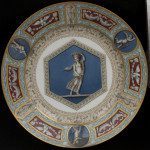
In 1883, Alexander commissioned the splendid Raphael service for Catherine’s Palace in Tsarskoe Selo. The design was based on the frescoes of the Raphael Loggias in the Vatican Palace, painted by Raphael’s pupils after his sketches and under his guidance. An exact replica of the Loggias was installed in the Winter Palace under Catherine II that served as a reference for the Raphael Service. It took twenty years to produce the Service, and in 1904, it was delivered to the court of the Dowager Empress Maria Fedorovna.
In 1888, the Imperial train derailed, and Alexander III single-handedly lifted the roof of the car from the wreckage allowing his family’s escape. During this rescue effort, the Tsar injured his kidney, leading to his death 6 years later.
-

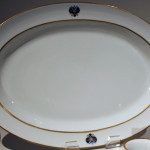
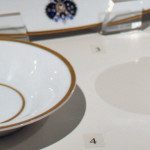
- Platter, 1883 Coronation Service (Nicholas II edition)
-
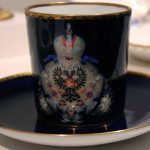
- Cup and saucer, 1881-1894
-
- Cup and saucer, 1883 Coronation Service
-
- Presentation Easter egg, images of St. Alexii, 1887-1890s
-
- Presentation Eager egg (cipher of Empress Maria), c. 1890
-
- Presentation Easter egg, c. 1883
-
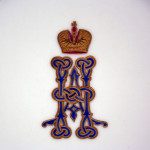
- From the dessert plates (1899-1900)
-
- Plate, Raphael Service, late 19th century
-
- Presentation Easter egg (cipher of Alexander III), c. 1890
-
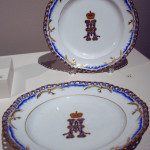
- Pair of dessert plates, 1899 and 1900